
Written By John VanDerLaan
*We may earn revenue from the products available on this site and participate in affiliate programs

I caught my first spanish mackerel fishing in the Gulf Of Mexico out of Long Key, Florida more than 45 years ago and it has been a love affair ever since. In this article, I will show you how to catch spanish mackerel with tactics that will work from a pier, from a boat, from the surf, anywhere they swim!
Spanish Mackerel Tackle

The best spanish mackerel fishing tackle depends on which fishing technique you are using. There are three primary techniques for catching spanish mackerel. They are casting, trolling and fishing live bait. I use the same spinning tackle for casting and fishing live bait and conventional tackle for trolling.
My favorite rod for casting and live bait is a 7' 6" St. Croix Premier, medium power and fast action spinning rod paired with a 4000 series Daiwa BG MQ spinning reel. I love the BG MQ because it has a one piece sealed body that keeps saltwater, sand and other debris out of the reel.
I also use the same rod paired with a 4000 series Shimano Vanford spinning reel. The Vanford is a much lighter reel and ideal for long days of casting without fatigue.
For trolling I use size 30 Penn Squall lever drag conventional reel paired with a 7' Penn medium power, fast action rod.
Rigging For Spanish Mackerel
Spanish mackerel have a mouth full of very sharp teeth and can cut your line very easily. To combat this and help prevent cut offs, I use a 40 lb monofilament or fluorocarbon leader attached to my main line, which can be either braid or monofilament.
I attach about 3 feet of leader to my main line with a double uni knot. I also tie whatever bait or lure I am using directly to the leader. Do not use a swivel, because the mackerel will actually bite the swivel and cut your line.
Many anglers use a wire leader, but when fishing in clear water, a wire leader will drastically reduce the number of fish that you will catch.
Where To Find Spanish Mackerel

Spanish Mackerel can be found anywhere. One of the easiest ways to find them is to look for diving birds. Under the birds will be fish busting small baitfish. Usually either bay anchovies, glass minnows or even pilchards.
I like to fish around jetties and passes, even bridges, but you can find spanish mackerel in any of the waters of the Gulf of America or the Atlantic Ocean.
One of my favorite ways to find spanish mackerel is to anchor my boat in an area with good current and drop a chum bag with a block of frozen chum in the water. In a very short time, you will have bait fish in the chum line and the mackerel and other gamefish will be right behind them.
Casting Lures And Live Bait For Spanish Mackerel
This my favorite way to fish for macks. Spanish mackerel are very fast, high strung gamefish and they prefer lures with a high speed retrieve that mimics a fleeing baitfish. In my experience, very few spanish macs will hit on a slow retrieve. You may get multiple fish following your lure, but they won't hit unless you speed it up or make it erratic.
They also like shiny and flashy lures that can attract their attention from a long way away in clear water.
When fishing with live bait, I like to drift the bait back in a chum line. You can do this from a boat, pier or even a bridge.
What Is The Best Bait For Spanish Mackerel?
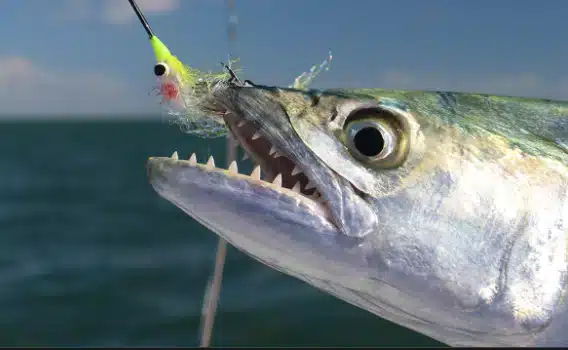
Though most anglers will fish for Spanish with artificial lures, if you can cast net some bait in the shallows you can use just about anything alive or dead to catch smacks if you know where they're at.
The best live bait for spanish mackerel include pilchards, bay anchovies, sardines and shrimp.
For live bait, put a hook in the mouth and out through the nose area and then another one just in the dorsal skin to make sure you hook the fish. For shrimp, I like to hook them in the tail. You can either thread the hook from the end of the tail towards the carapace, coming out just before the carapace, or simply put the hook in one side of the tail and out the other
Here is a great video showing how to hook live shrimp for spanish mackerel.
RELATED: Best Surf Fishing Reels
Best Spanish Mackerel Lures
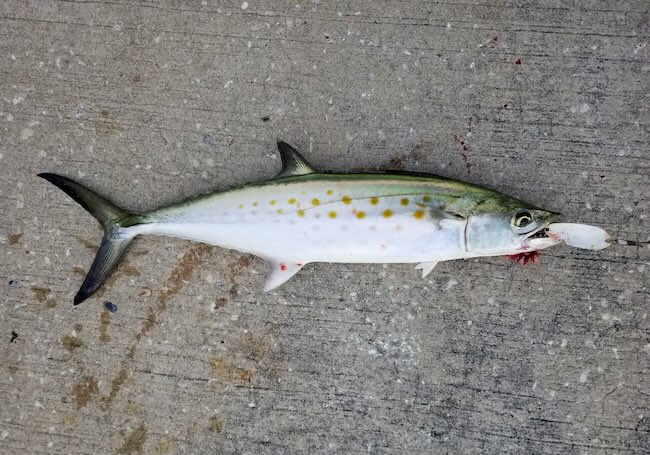
Casting Spoon

Casting spoons are a staple of Spanish mackerel fishing and you should count on this lure as the first one you cast to see if fish are around. A spoon like this will catch all kinds of fish because most fish love to see the flash of a small fish in the water close to them. It gets them excited and ready to feed.
My favorite spoon for spanish mackerel is the Kastmaster spoon. I carry it in a number of sizes, but most often use the 3/8 ounce and 3/4 ounce sizes.
These spoons are streamlined and great for casting long distances and covering a lot of water when blind casting.
You can get them from Amazon by clicking here.
Gotcha Lures
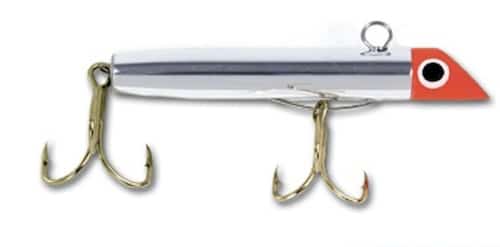
Got-Cha lures are very popular with anglers targeting Spanish mackerel, jacks, bluefish, and other fast fish that chase shiny lures. These lures are effective and last for years if you take care of them.
Pulling a Gotcha through the water you may be surprised at how it rips through very fast with little drag. It is heavy and very easy to toss a long distance. Many folks use a bigger surf rod and launch these from the piers way out, especially with the wind at your back! Casts of 100 yards are not unheard of.
Spanish macks love these lures and you should always have a few of them in your tackle box. This is a lure that ensures you catch fish and don't lose too many because it has a double treble hook that's quite sharp right out of the package.
I've caught amberjack, cobia, snook, redfish, snapper, jacks, bluefish, and spanish and king mackerel on these incredible lures. You may not even need to use anything else.
You can get from Amazon by clicking here.
Jerk Baits

Jerk baits or rip baits are deadly when fishing for spanish mackerel. They are fished just like the name sounds. You rip the bait through the water and then pause while you take up the slack, then rip it through the water again. This action triggers strikes, usually on the pause, so you better be hanging on tight to the rod. My favorites are the Yozuru 3DB Jerkbait in prism silver blue and the Rapala X Rap in either white or silver.
Jig Head And Plastic Grub

Jig heads with soft plastic grubs are renowned for catching all kinds of fish and for being one of the most productive lures you can fish with. My tackle boxes are full of a huge variety of these sorts of lures of every color, size, and smell. You can get the plastic parts in a smelly solution too which I think helps a bit.
Catching macks with these baits is easy and consistent. If the fish are around, you'll be catching them with a fast retrieve of these lifelike lures.
The only issue I have with fishing soft plastic lures is that with toothy fishes like mackerelm you're going to lose parts of the lure with strikes. Even after catching just one fish your lure can be destroyed and need to be replaced.
The best jig for spanish mackerel is a 1/2 ounce jig head with a white soft plastic grub. You can use a 1/4 oz. to 1/2 oz. jig and 2"-5" grubs. Most people use these small jig heads successfully but sometimes the current will force you to use larger and heavier jig heads. All of them can be productive.
Trolling For Spanish Mackerel
While I prefer casting with spinning tackle, trolling can be super effective for catching spanish macks. One of the most important factors when using this technique is speed. I like to troll between 5 and 7 knots and I primarily use spoons.
RELATED: The Ultimate Guide To Fishing Sarasota Bay
You can use heavier spoons like large Kastmasters to fish the upper water column, but when the fish are a little deeper, you will planers or trolling weights to get them down
Clark Spoons For Spanish Mackerel

Clark spoons are lightweight, long slim spoons that move through the water like a small bait fish. The silver and gold colored ones flash like spoons and diamond lures. They are longer than other spoons and can move fast through the water.
This are super productive for mackerel and a great way to cover a lot of water to find the macks.
These Clark spoons are hard to cast, they are so lightweight, but they are ideal for trolling. You'll need a planer or some trolling weights to get the spoon down under the water where the fish are.
You will need 2 ounce trolling weights connected to your main line and then 8-10 feet of leader attached to the clark spoon.
Planers work well by taking the spoon down 5-10 feet. The apply a lot of pressure to the rod as the plane downwards, but when a fish its, the planer is tripped and the pressure released so that you can fight the fish.
You can get clark spoons at Amazon by clicking here.
Catching Spanish Mackerel From Shore

Spanish mackerel are not just for boat anglers, they are readily caught from shore on both the gulf coast and in the Atlantic Ocean.
They are caught by casting artificial lures and with live bait and cut bait from piers, jetties and bridges. The most successful anglers will use chum to bring the macks within casting distance.
Spanish mackerel are not really attracted to the structure of piers, jetties and bridges, but he baitfish are, and that is what bring the macks in.
Begin with any of the bait or artificial lures we talked about. Fish incoming tides and clear water areas, especially near piers.
Surf Fishing For Spanish Mackerel

RELATED: Best Surf Fishing Rod And Reel Combos
Spanish mackerel are also readily caught while surf fishing from the beach. The most productive method is blind casting while walking the beach and looking for diving birds.
RELATED: Tips And Techniques For Beach Fishing
The schools of mackerel are constantly moving so the idea is to move and run into the school. At which point you can continue to move with the school and catch multiple fish before they move off.
What Is The Best Time To Catch Spanish Mackerel?

Incoming tides during dawn or dusk produce a lot of fish but you can't ignore water temperature and weather. The worst time to fish for spanish macks is when the water is cold.
Water temperature of at least 70°F or much warmer is when they feed. The warmer the water the better, to a point. South Florida from March to September is always good for these fish and there are tens of thousands caught annually.
Fish ant time of day when the tide is moving in or out a fair bit during that time. And if there is a tidal change before or after that, you should have a full fishing session.
Here's a Summary of Pro Tips to Help You Catch More Spanish Mackerel
- Mackerel move very quickly so vary your retrieve between medium and very fast to entice them to bite. Slow it down if you don't get bites.
- They feed when the water is warm to very warm. On hot days when the water is clear, you will find more fish.
- Clear water is essential.
- Flashy lures moved quickly are better than anything else.
- Swivels are attacked by mackerel because they look like tiny fish. Tie line directly to the leader when fishing for macks.
- Check your line often for damage, mackerel teeth are razor-sharp.
- Spring and just before winter are when they migrate, so targeting during that time can produce many good-sized fish.
- If trolling, speeds of between 5 and 10 knots are recommended.
- Spanish mackerel may not always be on the surface, don't be afraid to go deeper in the water column, by using a planer when trolling.
- Diving birds and breaking fish are a sure sign that mackerel are feeding aggressively.
Why Catch Spanish Mackerel?
They're just fun to catch, first of all. Any fish that chases something shiny and fast through the water is fun to catch if you ask me. They have sharp teeth and can sometimes chew through your mono or fluoro lines so you have to be a little creative to catch them consistently without breaking your line.
You have to employ tactics to catch them. I like a challenge as much as anyone, and there are too many fish in the ocean that don't require any effort to catch. Landing some nice mackerel depends on your tackle, rigs, location, and the season you fish.
They also make great baits for tuna, striped bass, bluefish, swordfish and many other large predatory fish.
If you listen to the hype, many people will tell you that eating these fish is not recommended. They're oily. They taste too much like fish or they have 'that fishy smell.'
I listened to friends for years and didn't try one myself until after I'd been catching them for at least five years. In Florida we have a lot of other fish to eat that are hard to match, so really there was no need to even try a fish that other people said wasn't worth the effort.
RELATED: Best Fish To Eat In Florida
Fried, baked, or grilled, Spanish mackerel are a great fish to eat, and if you're in an area where they are you will find a lot of them. Mercury content is high, so limit yourself to eating just three servings of this per month, and don't use them for sushi.
Bleed all mackerel immediately and get them on ice. After bleeding the fish, you can filet Spanish mackerel just like you would any other fish.
Wrap Up
Spanish mackerel are a beautiful fish that is fun to catch and tastes great, if you eat them fresh. They're easy to find when it's hot and you can simply head to a fishing pier to catch them with lures already in your tackle box.
If you've spent time fishing along the Atlantic seaboard or Gulf Coast of Florida, Alabama, Louisiana, Texas or just about anywhere up the east coast of the US, you have probably hooked into some Spanish mackerel. They are everywhere when migrating and it's hard not to catch some!
RELATED: Florida Surf Fishing Species And How To Catch Them
Go catch yourself some and let us know how you did!
